Friday, September 7, 2012

O India!

O India!  To be honest, India is not a place I would ever have considered visiting, but the experience proved to be a great learning lesson, not just from the business perspective, but also from the humanistic.

At  first glance, your senses are bombarded by noise, crowding, pollution, smells, and chaos.  Audible, tangible, and visual chaos.  We were quite appropriately warned that if we cherish our systematic organization, we should be prepared for a shock when we entered India.  That couldn’t have been more accurate.  An activity as mundane and routine as crossing the roadway was an out-of-culture experience!

However, Indian culture also thrives on and demonstrates profound hospitality and polite manner.  Personally, I was not prepared for the level of service afforded to us on a daily basis, from our National Management School hostess that took us immediately under her wing to guide us through a crowded and disorienting early morning airport arrival in Chennai, to the daily assistance from practically every Indian citizen encountered. 

At our company site visits, we were able to see a more Westernized organization and calm to a degree.  Upon entry into L&T InfoTech’s massive and beautiful facilities, it was evident that the class was in for a treat.   From the very first contact with the company hostess, who was expecting us and received us with sincere interest and hospitality, to the final question and answer session in one of the modern classrooms, to the tour of the executive access only skywalk, company representatives and executives treated us to a professional and enjoyable experience and gave us a look inside a premier Indian engineering company.

In parallel with other observations of the country in general, L&T offered examples of service orientation, hospitality, innovation, creativity, flexibility, adaptability and cultural tolerance.

The concept of  collectivism  was evident in the call center we visited.  In cubicle spaces typically occupied by one person in America, Indian people tended to sit closer together, and occupy two to a space.  I saw many empty cubicles, and those with occupants always had two or more employees collaborating, discussing, or just working together.   In sharp contrast to the collectivist social norm of India where people are used to dealing with and adapting to the chaos of masses packed into precious small space, Americans tend to cherish and occupy more personal space.  Rarely will you see an American work cubicle environment where people choose to work together in close quarters for any length of time.  This affinity for collectivism is what makes the Indian culture ideal for workers that thrive in a team work environment.  Collaboration is expected and welcomed,  tolerance is inherent and adaptability is the norm. 

Another memorable site visit was to the community eye care clinic.  It quickly became evident that compassion, free care for the impoverished community, and world class quality in the provision of that care are indeed possible.  I’ve never seen a more organized, well run clinic environment, where clients could expect the same level of service (or better) than that would be found in a fee-for-service private health care provider’s office.

While the chaos and disparities are perhaps the noisiest memories, the biggest learning lesson to come home with me is that we have much to learn.  Societal norms already in place in a country with a massive population, young and upcoming professionals, and a developing education system all equate to great potential for business.  As more and more business and global economy enters India, and with the right pace of implementation and sustainability,  the better for business and for the country of India.

Thursday, September 6, 2012

Diverse India

Diverse India-
Though I am of Indian Origin, I have visited few places in South India. I realize difference between northern & southern India as we visited 2-cities which are extreme end of country -Delhi, in North & Chennai in South of India. Our visit to India began in Southern India- Chennai (earlier called Madras), Tamil Nadu, where English & Tamil are preferred language than Hindi, the national language. Most of conversation with auto driver, sales men at street would be in English, since most of us did not know Tamil.

Indian being secularism, one can see different religion being practiced and different religious worship places close to each other.

Shopping experience is always great in India as one can see crowd of people shopping all time with feeling of festival every day. Shops were filled with customer all time and did not feel of any economy slowdown . We  could visit and see the famous silk cloth stores -Nalli & Sundari in Chennai. Most of South India Silk is produced in Kancheepuram is also known as 'Silk City,  which is close to Chennai. It is amazing to see big departmental store, store of specialty goods, small shops and street hawkers selling different goods. Walking in crowd and traffic is also great experience.


During  our trip we visited companies having local & global presence from different sector - Nissan-Renault-Automative industry, L&T Construction- Heavy Engineering & Construction & L&t Infotech &  Cognizant-IT Software, Sankara Nethralaya - Eye Hospital in Chennai & AirTel- Telocom company in Delhi.

Chennai, India is similar to Detroit, US with large automotive companies from Nissan-Renault, Ashok Leyland, BMW, Daimler,Hindustan Motors,Ford, Hyundai, Mitsubishi,Royal Enfield,TAFE Tractors having manufacturing & assembly plants because of its strategic location to India coastal region, Sea Port and huge supply of Engineering graduate, skilled labor.

Engineer at  Nissan-Renault mentioned that most of the automotive parts are provided by local supplier in Chennai help their production and roll-out new model every 4-month. Their market being African, European & Indian market which helps company in sound economic position is today's global economy slowdown.

Introduction and showcase of projects completed and L&T really amazed me as L&T is able to deliver to India economy. L&T Heavy engineering & Construction
involved in important government work like dams, road, power plant, aerospace and specialty industrial equipment manufacturing. L&T though expand several area, its main revenue comes from construction business in India helping country infrastructure requirement. Some projects like rods, bridges and power supply are delivered on BOT concept - Build, Own till recover cost e.g toll on highway and transfer to India highway Authority/government.

Visit to Cognizant, IT company was not new to me, but help me understand company's effort to be global software consultant companies.
Visit to Airtel, Delhi- company from Communication sector was different for me. With huge demand for growth in India & African Nation, communication industry
in India has great potential

My most liked company visit was Sankara Nethralaya also known as 'The Temple of the Eye' not-for-profit charitable Eye Hospital in Chennai, India. They perform more than 100 eye surgeries giving vision to rich & poor at their facility in country. The center also has mobile hospital developed with help of engineers from IIT, Chennai, which is use to provide service in remote region of country. They are able to manage their research, eye care, hospital and other services and low affordable cost to poor people.

Meeting with CEO's & other executives of different companies in Chennai, India at Corporate Dinner at Surana & Surana facility arranged by NMS was also great experience to know some insight of corporate world. We were able to interact different executive one-on-one during dinner.

Visits to famous church in Chennai, Tomb of  Mogul, Akbar the great- at Sikandra, Taj Mahal-Agra, Modern-Lotus Temple, Delhi The Baha'i House of Worship (bulid by L&T Construction, Akshardham Temple in Delhi.


Our trip really include diverse experience with - Company visits of different industrial sector, sightseeing places of different religion, difference experience of south & north  people of India & food variety.

Thanks to  to Sankaran Raghunathan, Sundari from NMS, Prof:Sanjay, Prof:Don Purdy,Prof:Ray, team of Cohort Class of 2013 and other for making India Trip a wonderful experience.

Wednesday, September 5, 2012

Civics and Corporate Social Responsibility - this Missing Piece?

I considered myself to be “international” in thinking. In fact, I was quite excited when Don Purdy shared that we were going to India. I have traveled abroad on a few occasions and looked forward to a place vastly different from western culture. I am worldly – I mean I love Indian food and exploring different cultures. Sounds like the statement of a middle class ethnocentric American, which is exactly what I turned out to be.


The preparation for this trip started months before our departure – applying for a visa, vaccinations, medications, learning about the people and international business practice. This is peppered with enticing thoughts of the Taj Mahal, gold leafed Hindu temples and the pull of an exotic culture that you believe to be so vastly different from western lifestyle.  In addition, we hear about the exploding middle class in India and how their economy is one of the fastest growing in the world.  All of these things together provide context for our visit.  However, none of this prepares you for the shock of being on the ground inside a country with the second largest population in the world.

My first two days of observing the environment, culture and people was overwhelming. It was a mix of excitement for being some place different with sadness for what I perceived as a government failing to support its people. Where is the prosperity we heard about, the middle class, neighborhoods and sidewalks? The problem was, I needed to shift my thinking about what living actually was to other people. That middle class didn’t equal suburbia and SUV’s.

Chennai, our first destination, is a city that lacks infrastructure, clean water, refuse containment and adequate housing.  My first day walking around the city, I was startled by the children and women begging in the street – not just for money but for food as well. The crumbling roads and sidewalks as well as the garbage on the streets seemed surreal. It was difficult to understand how this could be the case. Yet, a short ride out of town and a turn into a technology park and one sees state-of-the-art structures and corporations. World leaders in industry – Infosys, L&T, TaTa, just to name a few. These are the corporations earning hundreds of millions of dollars, if not billions, in revenue.

Visiting several of these corporations and meeting company leadership was a great aspect of the trip. We had the opportunity to ask questions about human resource policy, finance, management practice and market strategy, however something I thought needed further discussion was corporate social responsibility. I struggled with this, how could I ask a question about the community and its condition without sounding condescending or ethnocentric? What responsibility do these corporations have to support the local community? It was difficult to know.


L&T created a public relations museum about their company, about innovation and infrastructure, about engineering and giving back to the community. Upon examining their examples of giving back, one can see their local investments as “shallow”. Some examples of giving back to the community included: sponsoring a cricket match; building a daycare for their workers; hosting company gatherings; and giving to name the wing of a hospital. Without the latter, all other examples do not improve the lives of those in the community who are not employees. How is a company like L&T, that builds water purification plants, airports, bridges, etc., thrive in a community where clean drinking water is not available? Support for energy and infrastructure were not examples of their contributions to the community nor was food or affordable housing.

There seems to be a disconnection between the haves and have-nots in India. Those who are educated and fortunate to be educated and working are taken care of by corporations – they receive pay that raises their standard of living and in some cases housed, fed or transported to and from the corporations. But those who are seen as have-nots, are not supported by robust social services. One did not see many not-for-profits nor heard about government programs that support individuals who do not have food, water or shelter. The second-fastest growing economy in the world can’t provide services or won’t?

There are several reasons far beyond my understanding that create this environment, but one can make a few observations. First, there are so many people that even the government could not tackle the need of the vast numbers. Second, the poor and middle-class of India have a strong dislike for politicians. Very few vote in elections and therefore one might believe that politicians would not pay attention to these members of society. Third, there is a saying of “live and let live” about the people of India. If one is born into a poorer life that is one’s lot in life and an effort to move you out of that social class is not important. And finally, unlike business in the United States, there is not pressure by peer corporations to invest in communities to compete for business.

The last thought on this subject of CSR or corporate responsibility came from a student at the National Management School. He commented that in order for India to move forward, to stop the brain drain to other countries or to entice industry leaders, researchers, entrepreneurs to come to India, their needs to be a sense of civics  - civics in terms of how people relate their lives to their communities, towns and regions. The sense that by investing in one’s community is investing in the future is not imbedded in India’s culture.  It is this missing piece – the social responsibility and civics – that will need to change for India to solidify its place as a leader in the global economy.  

Sankara Nethralaya Eye Hospital ... the Temple of the Eye!

“What strikes me most about India is not the tremendous difference between wealth and poverty which exists in our country, the gap between the wealthiest and the poorest but more than that, the gap between the sublime nobility of character on one hand and the total degradation on the other. This strikes me as the most glaring contrast about India.  When I come to an institution as this it replenishes my faith in the future of India.  It makes me feel that I am in the midst of human beings who are human and who will one day make this country proud by their dedication, by their sense of discipline and by service to their fellow men.” - Speech delivered by Late Sri Nani A Palkhivala (Eminent Jurist & Former Indian Ambassador to the USA
Our journey and adventure through India was filled with rich experiences.  The richest and most humbling experience that I had was our visit to Sankara Nethralaya Eye Hospital, which means “Temple of the Eye”.  Back in 1976 Dr. Sengamedu Srinivasa Badrinath, an ophthalmologist native to India who did his residency in the US, decided to take the road less traveled upon.  Dr. Badrinath could have lived the American dream as defined in modern American culture; instead he lived his own dream, to make a difference in the world, to help his fellow countrymen, and to dedicate his life to all of human kind through his expertise in the field of ophthalmology.
When you think of some of the most selfless people in human history names like Gandhi and Mother Theresa come to mind.  For me the image and name of Dr. S.S. Badrinath is now included.
What is impressive to me is that Sankara Nethralaya is not just a charity to help the poor, disabled, and less fortunate.  Rather it is an institution created to sustain its own existence by having a for profit pillar of the organization where the profits are used to serve those that cannot pay for eye care and surgeries and in addition to that to produce world class research and technology.
During our visit to Sankara Nethralaya we witnessed eye care being delivered in a more advanced and sophisticated way compared to the United States.  Sankara Nethralaya pushes the limits to meet the needs of the patients they serve by developing a high tech mobile surgery unit comprised of two vans where cataract surgeries could be performed in remote areas of India where there is no power, clean water, or clean air.  The barriers they were able to overcome to do this are impressive.
Articulating the challenges that Sankara Nethralaya and the entire country of India face when it comes to eye care can be summed up in a few “eye opening” statements:
Ø  There is one eye doctor per 900,000 Indians
Ø  60% of the blind in the world live in India (India accounts for 1/5 of the world’s population)
Ø  One major issue that Indians have is that they don’t have access to eye care in rural India because they cannot afford to get transportation to a major city for eye care.  The cost of transportation is $1.20 USD, equivalent to one day’s pay!
Ø  Educating people of the symptoms and need for eye care
Ø  Fundraising & Resources
As we pulled away in our tour bus from the nano bio-technology research center I thought to myself how this one man’s life work has made a positive difference in the lives of so many people.  His selflessness and dedication to a good cause is to be truly admired.  He is a real hero.  The visit to Sankara Nethralaya was an excellent experience for me to reflect on my purpose in life, how I can give more, and what I can do to make a positive difference in the world each and every day.
A living HERO ... Dr S. S. Badrinath

Nani A Palkhivala
Sankara Nethralaya Eye Hospital “Temple of the Eye”
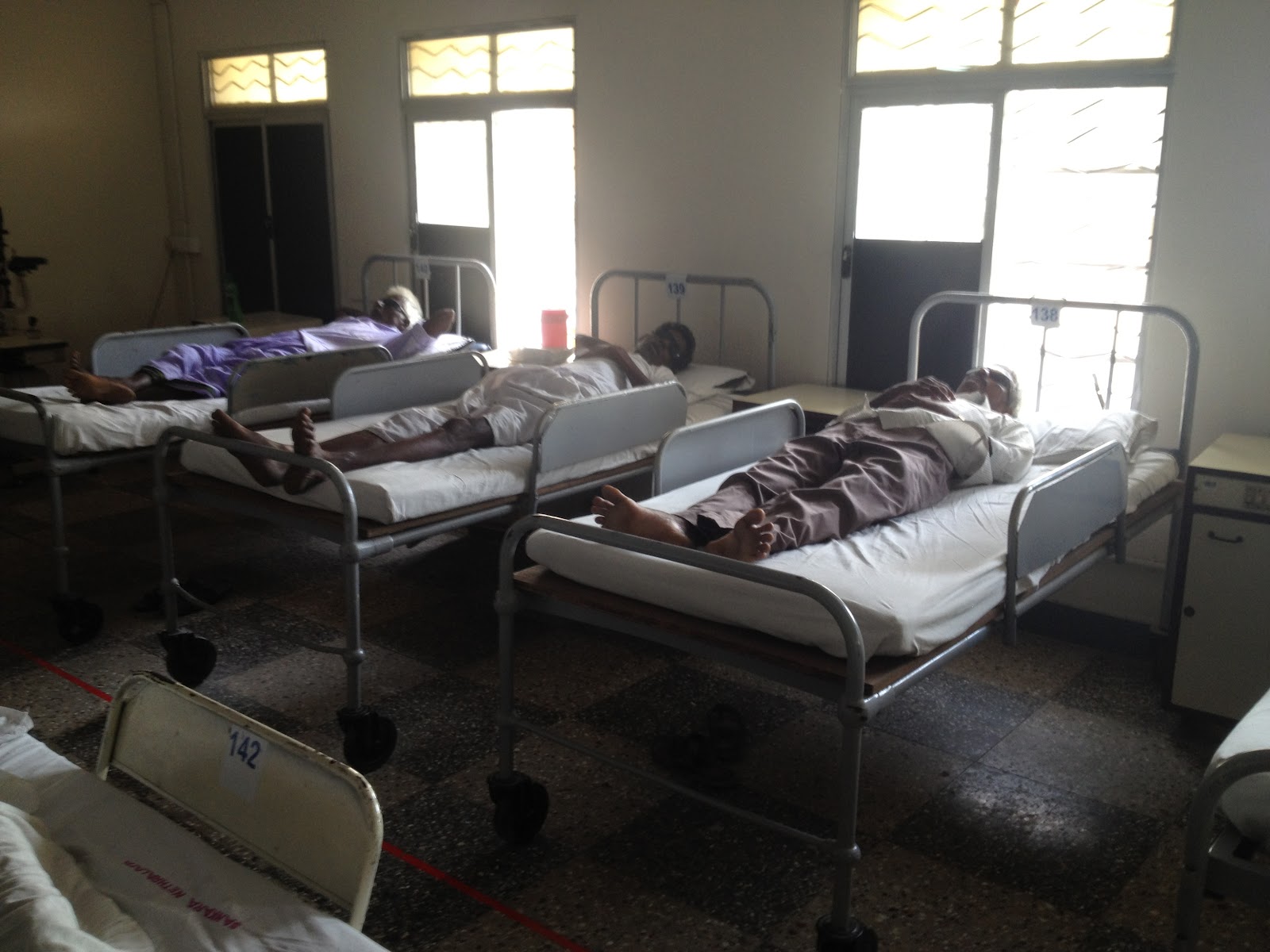
Below: Patients rest in the free eye clinic after surgery
Below: Sankara Nethralaya Research Center

Below: Dr S. S. Badrinath speaks to the U Albany MBA group

Below: Here I am sitting on an exam table in the free eye clinic manufacturered by Janak a medical equipment manufacturer in Mumbai that the company I work for purchased back in 2009.  A perfect example of having a "personal connection" regardless if you are 31 hours from home on the other side of the world.
Below: picture of a man with a vision disablity begging on the side of the road.  every person in the 3 minutes that i saw him gave him some money.
Below: we met in the waiting room of the free clinic to have a round table discussion about Sankara Nethralaya
While the (orange) building is not related to Sankara Nethralaya it is a great image of the high end eye care clinic and ultra modern architecture that you come across in India.  The other picture is literally right next door to this building.  How about that for contrast!


Tuesday, September 4, 2012

India.... One of the most unique places in the world

India.... One of the most unique places in the world....
It has been 14 years since I left India chasing the American dream. It is surprising how much has changed in these years, and in many ways, how little. While I found myself lost in the cities that I knew so well since all the landmarks are different now, I also noticed that the infrastructure, traffic, poverty, cleanliness have not progressed much since I left.

This trip to India was also unique for me. Travelling with my cohort allowed me to see and experience India in a different light and as a western tourist from a developed country. I was sensitized to aspects that I took for granted earlier and had found totally normal. I enjoyed the auto rickshaw ride with an added sense of adventure. This trip to India allowed me to reconnect with my roots and also see up close the change in professional India.

One of the unique things in India that is apparent off the bat (since cricket is the most popular sport) is how secular and tolerant the country and its citizens are.... We saw a church right next to a temple and a mosque not too far away. During the day, one can hear the Hindu temple chantings, church bells and Muslim calls for prayer. Unless you hear a name, one cannot recognize that people interacting are from different religious beliefs. People are cordial, welcoming and hospitality is big in the Indian culture.... "Athithi Devo Bhava" meaning Guest is God.

India presents several striking contrasts. Right from the airport upon arrival, one can witness the enormous gap between the different social strata. One can see high rise buildings with luxurious apartments and slums / shacks in the same 360 view. While one can notice luxury vehicles on the road, beggars cannot be missed either. There are reduced signs of the original caste system but the social gap seems to be ever increasing. There is a wave of urbanization going on in India and migration to bigger cities for work seems to be the key factor contributing towards increased upward social mobility and a growing middle class.

In India, we visited five companies viz. Cognizant, Shankar Netralaya, L&T, Renault-Nissan JV and Airtel. The selection of the companies from different sectors and with unique business models presented a significant learning opportunity with regard to the head and tail winds that each of the businesses were faced with. It helped me expand my understanding of the Indian market and challenges for conducting business there.

The international trip marked the completion of the first year of the MBA course and is truly the high point of the curriculum thus far. Having the opportunity to celebrate this milestone with my cohort friends and getting to know them better is priceless.

Friday, August 31, 2012

India Culinary Adventures

Ask anyone who has lived, worked or observed me over any significant amount of time and they will say that I love food. Not only do I love food they will say i’m extremely picky and critical of it. Most of the questions I received from family and friends before I left for India were along the lines of  “How will you eat?” or “How much weight do you think you will lose?”. I shared the same views. I was very pessimistic about my potential food intake. Amazingly, I actually gained 5 pounds and now have an appreciation for Indian cuisine.

The following are all of my India trip culinary adventures caught on camera.
This isn’t India yet, it’s actually at JFK. What I learned from this experience is never have bad chinese food at an airport with a nice glass of Montepulciano and then get on a 12 hour flight... and yes there were a couple of people present who can say “I told you so!”.


My first Indian breakfast. It was pretty good. The top left of the plate was some type of rice pancake that I could do without. Top right was sambar with some coconut and what I called Indian Donuts (sadly, I never knew their real name). I ended up eating a lot of sambar, it had great flavor. Bottom left was some type of spicy potato pancake that I loved. Lastly, on the bottom right, there was dosa. I later learned that the hotel’s breakfast dosa was by far the worst quality. It would be like getting steak and potatoes at T.G.I Friday’s and saying this is the best representation of that American food staple.

The banana leaf lunch! Which was the best lunch of the whole trip. The first time eating a meal completely with just my right hand that wasn’t a hot dog or hamburger. I liked everything that was served except for some pickled veggies that didn’t make it into this photo. The fried dough that was like potato chips was amazing. I honestly ate at least 5 of them. I actually loved the concept that they keep bringing you food until you fold the banana leaf up. I think IHOP should adopt the policy. The pancakes keep coming till that plates flipped, no more having to wave down the waitress.

Sadly I wasn’t able to get a photo of the culprit but this is the best I could do. If you follow Nithya's finger to behind the projection screen and had eaten a little bit from inside the buffet server you would have to agree that it was the worst pasta ever. I’m half Italian. When I originally opened it up I was delighted to see fusilli pasta with a  pesto sauce. Instead what touched my lips tasted like raw spinach, broccoli and some other green unknown vegetable blended up and served uncooked on pasta. Upon tasting it, half of my body wanted to take the contents of the dish and beat it a couple of times with a blunt object, roll it up in a carpet, throw it in a trunk, and then drive it to the nearest bridge and toss it off.


Now onto the best meal of the trip! Since a group of us liked the banana leaf lunch so much, and because Naveena was awesome enough to want to hang out with us, we experienced an amazing dosa meal at a local place she recommended. I plan on finding out if they have this someplace in the Capital District because it was just amazing. Besides how good this stuff tastes, I learned two other things about Indian restaurants. The first is that they are not used to one person ordering two entrees and three appetizers. It took some time for Naveena to convince the waiter that I wanted all that food. The second is their food is sooooooooo cheap. If I recall correctly, for around 16 dollars we got 9 entrees, 3 appetizers, and 3 bottles of water. Seriously, never turn down the chance of eating an onion dosa cooked in butter.
India actually has steaks! It was good. I really have to thank Gautam for the much needed vacation from liquid veggie sauces and dishes with small meat chunks. At that point of the trip I really needed just a giant chunk of meat to devour. For you cheapos out there, two filets cost about 12 dollars.


Now what better way to judge a country's food quality then by their junk food! Above,as modeled by Ulana, we have PoPo Cup Jelly (I preferred to refer to these as poo poo jelly cups) and Hippo round-round’s. The poo poo cups tasted like and had the texture of un-refrigerated jello. They were definitely not my favorite. The hippo round-round was basically like a garlic flavored cheese ball. I wish they had them over here because they were fantastic. 

Lastly, Crax corn rings. While having the texture of cheetos they had the flavor of something I never want to taste again. For something with the name Crax you would expect them to be addicting but they utterly failed in that category.
Above Jim demonstrates the appropriate way of thanking Jesus for American food franchises having opened up in India. As you can see, Pizza Hut in India is basically the same as Pizza Hut in America. The only difference we saw was in toppings and the delicious appetizer of meat on a stick. 

One of the my mains goals in India, even though it sounds foolish, was to try their version of a Big Mac. I love good food and bad (in so many ways) fast food. America is a fast food nation and I frequently eat at all of our chains. I needed to see what ours over there were like. I found out early on that KFC was exactly the same. McDonald's, besides the fries, was totally different burger-wise. They didn’t have our traditional beef burgers. They only had veggie, chicken and a paneer (which i’ll get to later).  Their version of the Big Mac is called the Chicken Maharaja. It was the worst fast food sandwich ever. It is the only fast food sandwich (Robert witnessed this) that I have ever taken 3 bites out of and stopped eating. Also note that just like in America the end product doesn’t really match the picture on the box. Thankfully the paneer sandwich I had from McDonald's made up for it. (see below). 
 
The McDonald’s McSpicy. is basically fried cheese. It proves that anything fried is good. Though I would warn people that the sauce was a little more spicy than what Americans consider spicy.

I’ve only been to three foreign countries in my life, Spain, Canada and India. I went to Spain in High School during a period where I refused to eat fish. Most of the cities I visited where coastal, this led to 90% of the menu being fish. I ended up eating a lot of salad which didn’t really leave a lasting impression and even then all their “ensalada mixtas” had canned tuna in it. Visiting Canada really wasn’t a foreign experience,  plus their bacon is a joke, so they automatically lose any culinary battle. Amazingly India has been the best experience culinary wise. I truly enjoyed most of the dishes that I had over there even though I couldn't pronounce them or in some cases tell what was in them.

Thursday, August 30, 2012

My India Experience


The one question I have been asked the most upon my return has been “Did you have fun?”  The India trip was an experience of a lifetime, don’t get me wrong.  However, fun isn’t quite the word I would use.  To be honest, I haven’t been able to find the most all-encompassing word to describe what exactly I experienced while I was there; humbling is all I have been able to manage.

Upon our arrival we were greeted by what seemed to be the entire city of Chennai waiting outside of the airport.  This would come to be a normal existence in India as you walk along any sidewalk or enter into any of the site visits, there are a lot of people anywhere you go.   I spent most of our very long bus rides staring out the window taking in what seemed to be a subject that isn’t talked about much there; the overwhelming poverty.  Everywhere we went there were beggars, or armed guards, or people sleeping on the sidewalk.  It was everywhere you looked but somehow not in any conversations we had with the business leaders we talked to.  Sure they discussed their “CSR” and how they are giving back to their communities, but I’m not sure any business in India could on their own even reach half of those in need.  I spent a lot of time reflecting on what we have in America and how truly thankful we should be.

The most resonating moment during the trip to India was the visit to Sankara Nethralya, a non-profit eye hospital committed to giving back to those who can’t afford the care they so desperately need.   Working in healthcare, there has been a large push in America to squeeze every penny out of they system that you can.  Physicians, hospitals and insurance companies feel they are entitled to their “fair share” of the pie, leaving a skewed non-patient centered care model to develop.  Both the founder of the hospital and the physician who worked at the free clinic displayed a passion that was the exact opposite of this.  You didn’t hear them say “what’s in it for me?” rather they both expressed sentiments that they are giving back to their community because they have the talent and the ability.  If only our healthcare system could step back and recognize it’s not about the money; it’s about compassion, quality care and ultimately healing people. 

There were a lot of cultural experiences that I hope to never forget.  Eating lunch off of a banana leaf, watching Joe attempt cricket at the top of a mall, rickshaw (auto) rides around town for $2,  the engagement party I attended with my friend who was visiting family in Chennai, and of course the Taj Mahal (which smelled oddly of urine on the inside).  I am truly thankful for the experience, but I think I’ll keep it to ONCE in a lifetime!

Wednesday, August 29, 2012

INDIA (Chuck-De-Phatte)


INDIA (Chuck-De-Phatte)
Travelling to India, for me, has always been like a time travelling experience. We lose a day when we go from USA to India. This travel we lost Saturday, as we started our journey on Friday and reached Chennai on Sunday Morning. Few of us tried to make up for lost Saturday by consuming few bottles of Kingfishers (white cap only) over breakfast, before retiring to our rooms after 20 hours of travelling.
I love going to India every year to visit my parents and friends, but travelling to India this time was a different experience for me, mainly because I was traveling with a group and plus I did not have to worry about any travelling details or plan. Everything was very well planned and organized by our Weekend MBA program team and its partners NMS folks. India, as a country was not a new experience but the activities we did was really interesting. We all went to different site visits and got a first-hand view of how companies do their business. It is quite amazing to see that in spite of various hurdles like traffic, multiple power outages and over population, India has grown so much in terms of economy.
We had a chance of visiting five different companies to learn and experience how business in India works. Of all the company visits, I enjoyed Airtel and Shankar Netralaya, Airtel for its youthfulness and innovation, Shankar Natralaya for its social cause.

We also went to various offsite spots. We went to a general shopping store (T-Nagar market) in Chennai, it was so crowded that it made me think that my friends from USA would not take it well, but to my surprise they seemed to have enjoyed it. Funny thing was Tom got a tie for himself at this store and by the time he got out of this store he had already lost the tie. We also had a chance to see some good dance numbers from NMS student, plus our own white boy was not far behind in teaching his “Gangnam style” moves. Type “PSY-Gangnam style” in YouTube to see how those moves have made it to limelight. Our trip to Taj Mahal in Agra and Akshardham in Delhi was also an amazing experience.
One thing I have come to realize when I visit India is that I miss “Burgers”. Knowing this, few of us ate Bobby Vans Juicy burgers at JFK before we started our India trip and ended the trip with more burgers at a rest stop on our way back to Albany.

Overall it was a great trip and an amazing experience. Still trying to master the art of “three in a box”.

Taj Mahal and more


I wrote this in India, but the hotel had Internet connectivity issues...here it is now...originally from August 5, 2012

Yesterday we were at the Taj Mahal, quite amazing. 
The wild 5.5 hour bus ride each way (Delhi to Agra and back) was also a memorable experience. 

Snake charmers, elephants in the river, rikshaw races and more!


Today, we visited a temple of Bhagwan Swaminarayan. He was a torchbearer of Indian culture and spirituality. The temple was astounding inside and out 

After lunch, we went to an outdoor bazaar and bought artifacts of Indian culture while testing our negotiations skills. I bought a leather work bag, and helped several friends buy some leather items. Small world: I met an MBA student going to Kellogg - and we exchanged emails. 

Only a sore throat and 5 or 6 mosquito bites in all, but wow they're itchy! Let’s hope these anti-malaria pills work...I suppose I should be grateful that I'm not running to the bathroom like some of the others in our group. 

10 days in India seems like a short trip to some, a long trip to others, but all in all, it’s just about right to visit enough companies, study their business models, make presentations, study, take a test, see several cultural and historical landmarks in three cities, and have a little time to experience the culture in person talking to students, professionals and Indian citizens. 

It was a great trip, and I feel much better prepared to work with Indian firms in the future, and look forward to that opportunity.

Rob